

Responsible fishing and field‑based data
Mauritania is home to one of the richest coastal marine ecosystems in West Africa, where marine biodiversity plays a central role in maintaining environmental balance and supporting the long‑term sustainability of fishing value chains.
In the face of increasing pressure on these sensitive coastal environments, the development of collective responsible fishing initiatives, grounded in science and field‑based observations, represents a key lever for preserving marine ecosystems.
It is within this context that the Mauritanian pelagic Fishery Improvement Project (FIP) operates. Supported by OLVEA since 2018, the FIP progressively integrates the preservation of marine biodiversity, coastal ecosystems and sensitive marine species into its continuous improvement actions.
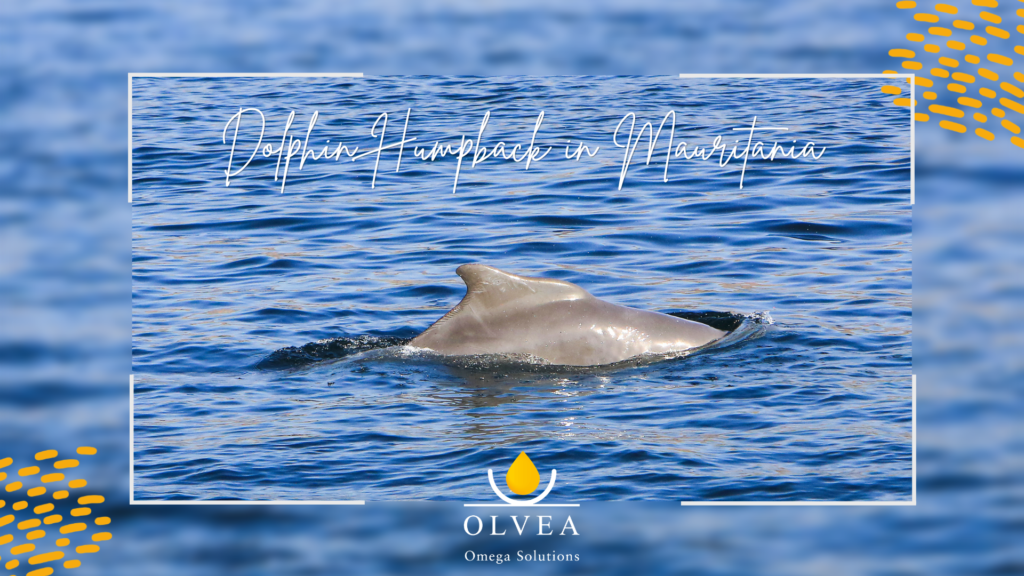
In 2025, particular attention was given to the Atlantic humpback dolphin (Sousa teuszii), an emblematic coastal species now classified as Critically Endangered on the IUCN Red List.
The Atlantic humpback dolphin: a sentinel species of West African coastal ecosystems
The Atlantic humpback dolphin is an endemic species of the tropical and subtropical eastern Atlantic, with a geographic range extending from Western Sahara to southern Angola.
In Mauritania, its presence has been historically documented, particularly in the Parc National du Banc d’Arguin (PNBA), one of the most important marine biodiversity hotspots in West Africa.
This species inhabits exclusively shallow coastal waters, where it lives in close interaction with human activities. As such, it is considered a key biological indicator of the condition of coastal habitats and of the pressures affecting marine and coastal ecosystems.
2025 survey: what field data reveal along the Mauritanian coast
To better document the current presence of the Atlantic humpback dolphin along the Mauritanian coastline, a perception survey was conducted in 2025 among artisanal fishing vessel captains operating in the PNBA and in the Mheijrat area, south of the park.
Key findings from the field survey
- Confirmed presence in 2025 : The vast majority of fishermen interviewed reported having observed the Atlantic humpback dolphin during the year, including very recent sightings.
- Identified occurrence areas : Observations are particularly frequent in the Iwik area, around Tidra Island, while also extending across the Banc d’Arguin and as far south as Mheijrat.
- A species perceived as rare but present year‑round
More than 97% of respondents consider the Atlantic humpback dolphin to be rare, although observable throughout the year.
These results do not constitute an exhaustive population assessment. However, they provide valuable field‑based data, consistent with existing scientific literature, and useful for guiding management and conservation efforts.
The observations collected indicate that the Atlantic humpback dolphin predominantly frequents areas distinct from the main small pelagic fishing zones, thereby limiting potential interactions with regulated fishing activities.
Pelagic FIP in Mauritania: a collective approach supporting marine biodiversity
The preservation of marine biodiversity in Mauritania relies on a progressive, collective approach tailored to local realities.
The Mauritanian pelagic FIP is notably built on:
- cooperation with local authorities and scientific institutions,
- the direct involvement of fishing professionals, who play a key role in observing marine ecosystems,
- the gradual integration of environmental considerations, including sensitive species and coastal habitats,
- the implementation of pragmatic improvement measures compatible with the socio‑economic sustainability of fisheries.
This collective dynamic helps strengthen the protection of coastal and marine ecosystems without placing biodiversity conservation in opposition to fishing activities.
OLVEA’s vision: building responsible and sustainable marine value chains
For OLVEA, its commitment to the Mauritanian pelagic FIP reflects a strong conviction:
The sustainability of marine value chains depends on collective frameworks built on science, observations and continuous improvement.
Supporting such initiatives means contributing to more responsible fishing practices, where marine biodiversity preservation, supply continuity and respect for coastal ecosystems progress together, for the benefit of both value chains and local territories.
